
 6 June 2026
 Pune's Fiscal Paradox: Merged Villages, Missing Revenue
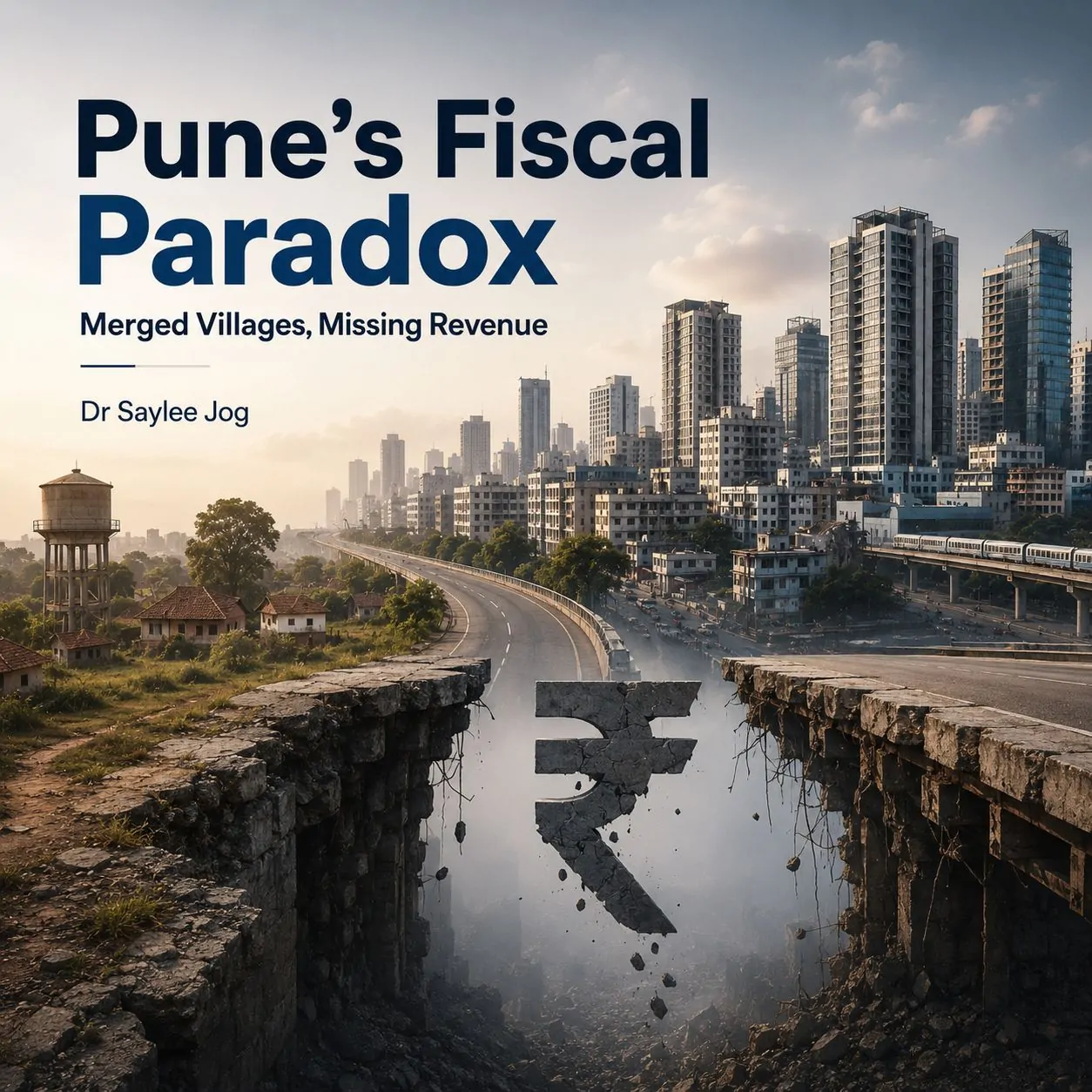
India’s rapidly urbanizing cities routinely absorb surrounding villages and peri-urban settlements into their municipal limits. The administrative logic is straightforward: as populations spill beyond city boundaries, extending municipal jurisdiction helps bring these areas under planned governance and service delivery. Pune has followed this path, with the Pune Municipal Corporation incorporating 32 peripheral villages over the past decade. What has not kept pace, however, is the fiscal framework that should accompany such expansions. The corporation’s pending claim for over ₹1,886 crore in GST compensation from the state government brings this gap into sharp focus and points to a broader structural issue in the financing of Indian cities.
The mergers happened in two rounds. Eleven villages were absorbed in 2019 and 23 more in 2021. Two villages, Uruli Devachi and Phursungi, were subsequently demerged, leaving PMC managing 32 villages today. Each round expanded the corporation’s service perimeter without a corresponding revision to its revenue entitlements.
The fiscal numbers reflect this gap clearly. Expected GST returns from merged villages have grown nearly sixfold over seven years, from ₹65 crore in 2017-18 to an estimated ₹390 crore in 2024-25. Villages like Wagholi, Manjri, Bavdhan, and Lohegaon have seen significant residential, industrial, and commercial growth since the merger, making them meaningful contributors to the GST pool. However, this contribution has not translated into direct revenue for the corporation responsible for servicing them.
To understand why, one has to go back to 2017. Until then, the Local Body Tax served as a direct revenue stream for PMC. Its abolition under GST rationalisation was replaced by a state-administered monthly grant, currently at ₹225 crore per month and set to rise to ₹242.50 crore in 2026-27. This transition effectively converted a locally generated revenue source into a transfer dependent on state-level decision-making. For a corporation of PMC’s scale and growth trajectory, that is a meaningful structural shift.
Since 2017, PMC has consistently written to the state’s Urban Development Department requesting that GST returns from transactions within merged villages be credited to the corporation. The most recent such letter was sent in October 2025. Nine years on, no formal decision has been taken. In the meantime, these villages continue to need investment in water supply, roads, solid waste management, and sewage infrastructure. On-ground progress has been slow, and property tax assessments for merged areas remain unresolved, further limiting PMC’s independent revenue base.
This is a well-documented pattern in urban fiscal literature: expenditure responsibilities are decentralized to local governments while revenue authority remains with higher tiers of government. What makes Pune’s case instructive is that the revenue in question is not hypothetical. It is generated within municipal limits, it is quantifiable year on year, and the data clearly shows it is growing with urbanization.
A formula-based devolution of GST proceeds to urban local bodies, one that is updated as municipal boundaries change, would go a long way in addressing this. For a city growing as rapidly as Pune, aligning revenue flows with administrative responsibilities is not just a fiscal matter. It is fundamental to the quality of urban governance. Without that, the gap between what cities like Pune are asked to deliver and what they are equipped to finance will only widen as urbanisation accelerates.
-Dr Saylee Jog
Assistant Professor, Gokhale Institute of Politics and Economics