
 7 July 2026
 DP of Pune's 23 Merged Villages: The Real Test Begins
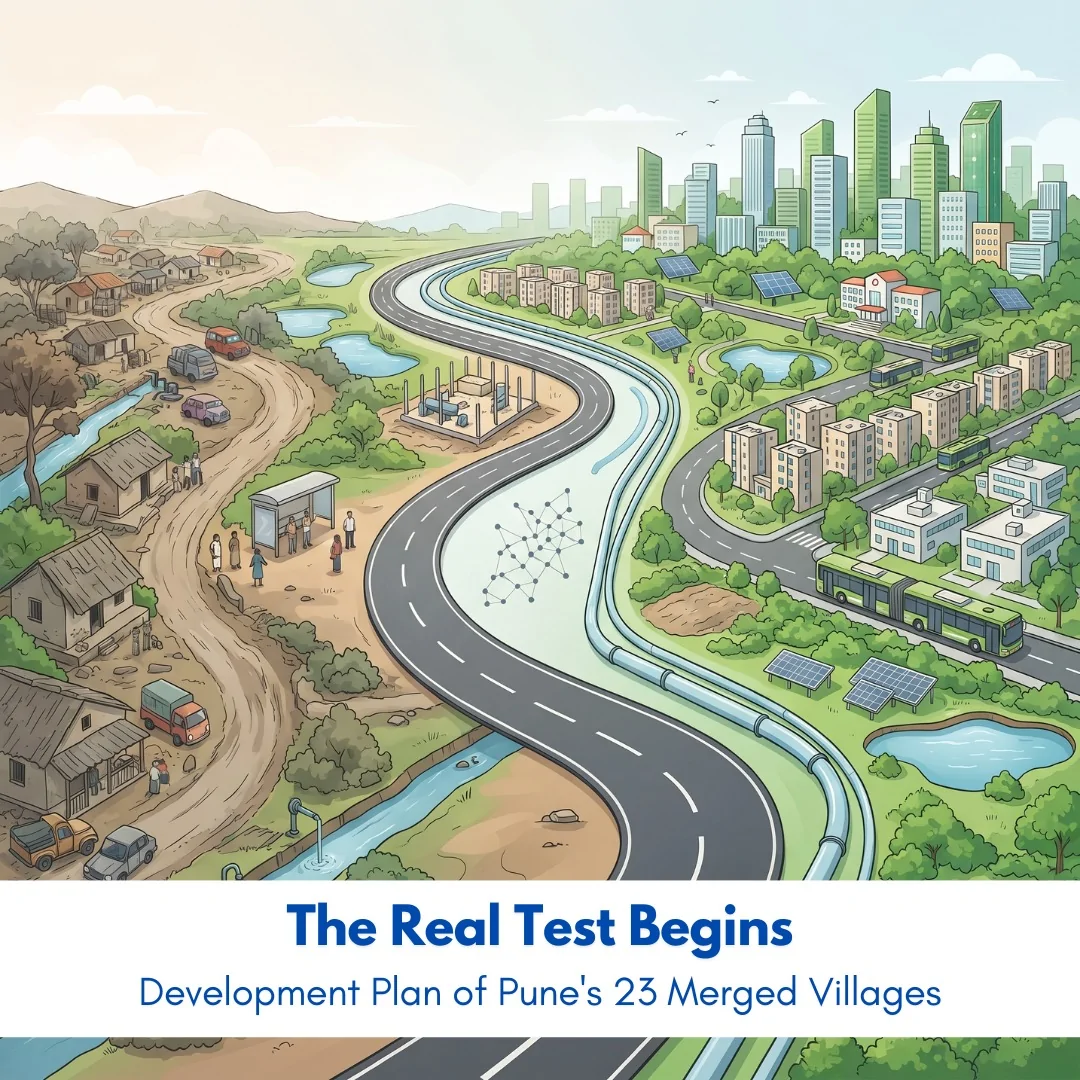
The long-awaited development of the 23 villages merged into the Pune Municipal Corporation (PMC) has finally gained momentum. At the PMC General Body meeting held on 22 June 2026, approval was granted to prepare a separate Development Plan (DP) for these villages. Simultaneously, City Engineer Aniruddha Pawaskar was appointed as the Town Planning Officer, with the objective of completing the plan within the next three years. Since these villages were merged into the PMC in 2021, they had remained trapped in administrative uncertainty. Although residents were paying municipal taxes, they continued to be deprived of urban-level civic amenities. With the transfer of planning authority from the Pune Metropolitan Region Development Authority (PMRDA) to the PMC on 22 June 2026, the way has finally been cleared for the planned development of these villages.
A Development Plan is far more than a document that determines land zoning or road layouts. It serves as the fundamental blueprint for a city’s future growth. It guides the long-term planning of roads, water supply, sewerage systems, public transport, schools, hospitals, parks, open spaces, industrial zones, commercial areas, and environmental conservation. Without a comprehensive plan, urban growth is often dictated by market forces, resulting in unplanned construction, traffic congestion, flooding, water shortages, and environmental degradation. The haphazard development witnessed in these 23 villages over the past several years is a clear example of this. Therefore, the proposed Development Plan is not merely an administrative requirement but a strategic roadmap that will shape the future of these areas.
The merger of rural areas into a municipal corporation is not simply an expansion of administrative boundaries; it represents a social commitment to provide urban-quality infrastructure and public services to residents. Once villages are incorporated into the city, the municipal corporation assumes responsibility for essential services such as roads, drinking water, drainage, solid waste management, healthcare, and public transportation. However, residents of areas like Wagholi, Mahalunge, and Baner-Bavdhan have continued to struggle with poor roads, inadequate sewerage, insufficient water supply, and traffic congestion for several years. This reflects not only a failure of infrastructure development but also weaknesses in urban governance. A capable urban administration must ensure that adequate infrastructure exists before granting permission for new residential or commercial developments.
Administrative conflicts further complicated the situation. The absence of a clear division of planning and development responsibilities between PMC and PMRDA resulted in delays and confusion. In many cases, one agency granted development permissions while another was responsible for providing civic infrastructure. Consequently, residents neither received timely services nor could accountability be clearly established. With planning powers now consolidated under the PMC, decision-making is expected to become more coordinated and accountable. Nevertheless, preparing the Development Plan is only the first step; its implementation will be the real challenge. Completing the plan within three years is an ambitious target. The process will require balancing changing land-use patterns, protecting agricultural land, safeguarding the interests of traditional farmers, accommodating rapid urbanization, and maintaining ecological sustainability. In addition, regulating unauthorized constructions, undertaking redevelopment where necessary, and reserving land for public purposes will require careful and transparent planning based on scientific principles and active citizen participation.
Among all the issues facing these villages, water management is perhaps the most critical. Pune is already experiencing increasing pressure on its water supply due to rapid population growth. The addition of these newly merged villages and their future expansion will only intensify this challenge. Merely extending water pipelines will not provide a sustainable solution. The Development Plan must therefore incorporate rainwater harvesting, wastewater treatment and reuse, conservation of local lakes and streams, groundwater recharge, and scientific management of water resources. In the era of climate change, water planning is no longer just an engineering issue—it has become a fundamental requirement for sustainable urban development.
The PMC should also adopt a phased development strategy. Large residential and commercial projects should be permitted only in areas where essential infrastructure such as roads, water supply, sewerage systems, and public transport is already in place. Otherwise, citizens will ultimately bear the burden of inadequate public services. Furthermore, the preparation of the Development Plan should actively involve local residents, community organizations, urban planners, environmental experts, and professionals in the field of urban planning. Such public participation will ensure that development is more realistic, inclusive, widely accepted, and sustainable.
The significance of this initiative extends beyond the development of Pune’s 23 villages. Across India, many cities are expanding through the incorporation of surrounding rural areas. Pune’s experience can therefore serve as an important model for other urban centres. These villages represent not merely the geographical expansion of Pune but an opportunity to demonstrate planned, environmentally sustainable, and citizen-centric urban development. However, the success of this initiative will depend not simply on the approval of the Development Plan, but on the administration’s ability to implement it efficiently, transparently, and with a long-term vision of sustainability, supported by strong political commitment and active citizen participation.
Ajit Deshmuk
Team PRO