
 12 May 2025
 Challenges And Possible Solutions For Sustainable Water Management And Security In Urban India
~ Varun Salvi
Introduction;
This research paper aims to explore the challenges and possible solutions regarding water security and sustainability in India. Initially, it will explore challenges this country faces in securing sustainable water resources followed by possible solutions to these issues. This research paper will explore existing public policy, legislation, finances, infrastructure, water resources to identify, in depth, the challenges, the issues and then possible solutions to resolve this important, if not the most important problem our country faces, water being a resource essential to human life and secondary purposes such as industrial development, agriculture etc.
Challenges;
Policy related challenges;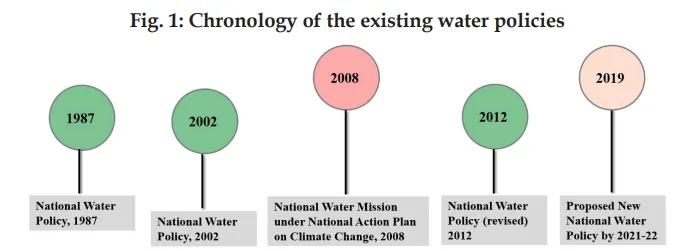
(Image Source; Structuring of Water Policies in India: An Overview and Way Forward; MAHESHWARI GUPTA*RABIDYUTI BISWAS**)
A credible research paper from the ORF states that India is desperately in need of strong and clear legislation related to water governance and the formation of a new nationwide water policy (Nilanjan Ghosh, 2024). India utilises a reductionist approach towards water resources by merely splitting surface water resources based on political boundaries which is the apparent cause behind frequent Centre-State and Inter state disputes due multiple and convoluted legislation. India continues to use the dated NWP 2012 which led to rapid constructions of dams and other related infrastructure for monetary and economic development without considering ecosystem depletion, these factors were identified in various policy drafts carried out till 2021 under the Ministry of Jal Shakti with recommendations from an independent committee which would ensure a National Water Policy however these drafts never progressed to further stages or the introduction of a bill of any kind. Although previous legislation gave the country the capability to redirect water resources using infrastructure to areas of need it failed to consider sustainability and a long-term approach leading to the depletion of river basins. Acknowledging the importance of fresh policy and legislation to ensure sustainable water security several nations in Europe and the West have dismantled infrastructure based policy yet India lacks
coherent, national legislation, instead implements single initiatives such as Jal Jeevan Program which are essential as well.
Critical Infrastructure Issues for Treatment and Delivery;
According to multiple resources, it seems evident that India lacks the infrastructure to treat and deliver potable water to its population. The UN SDG report published in 2019 provides alarming evidence of this fact. According to the report 3 in 10 lack basic drinking water facilities and majority of households lack access to water on premises(retrieved from a post by Rakesh Bhatt, State Consultant Swach Bharat Mission). StartupIndia.gov identifies 2 crucial challenges related to infrastructure in water management. First, the lack of treatment facilities to convert grey water and sewage water to an acceptable level before releasing into existing water bodies which results in close to 70% of untreated sewage being directly released into rivers etc. The second challenge being lack of purification and treatment facilities when the water is re-utilised hence resulting in unsafe water being delivered to the end user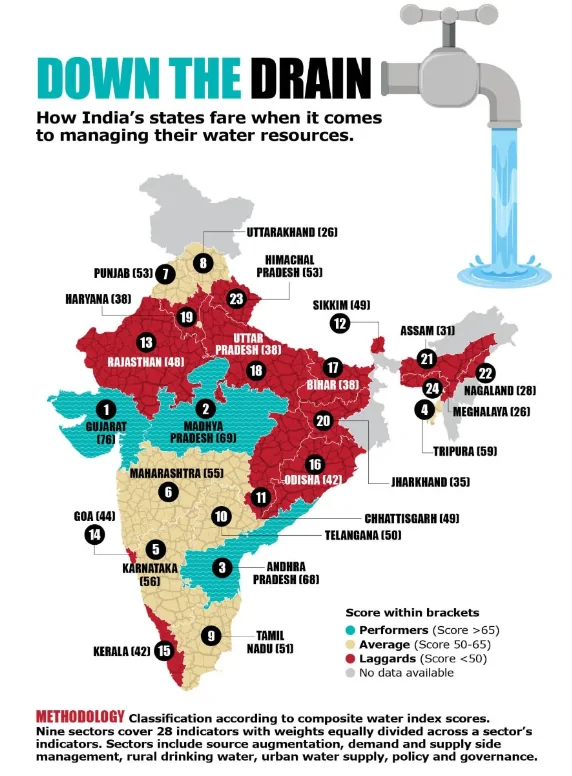
(DPIIT, 2025).
(Image Source;India Today; India’s Water Crisis: Can a new ministry fix our water emergency?)
Ageing and obsolete water delivery infrastructure is also of great concern according to and Indian Express article published in 2024 which reported that the city of Mumbai alone loses 700 million litres to leakages and damaged infrastructure while on the other hand a NITI Aayog report states that 5 of the largest cities suffering from water shortage in the world index out of 20, are situated in India (The Indian Express, 2024).
Financial Constraints;
A detailed report by Water Digest which discusses the funding requirements for India to achieve optimum water security and sustainability. It lists out obsolete water delivery methods, leakages and spillages in urban cities and lack of water treatment facilities being some of the major areas of infrastructure that requires attention while pointing out that India spends the lowest percentage of GDP on infrastructure as compare to other South Asian countries at 6% compared to 11% of China and would require additional USD 129 Billion to cover the shortage in infrastructure. India struggles with allotting funds for water management because according to the report it, the government would prefer to keep it a subsidized commodity for the public which deters private participation due to the absence of profits which in turn hinders speedy development and in today’s situation majority of the funds are invested by the government and international aid organisations. The government must overhaul their revenue and investment mechanism in this field to ensure sustainability and security (SETHI).
Possible Solutions;
As seen above, India requires a major upgrade in its Water Policy as well as Investment efforts. In terms of policy, multiple credible reports state that India must progress forward from the NWP 2012 and move onto the draft bill with recommendations from the Mihir Shah committee (Education, 2022), which in my opinion is accurate, since the committee and its recommendations have been made based on consultations with various stakeholders right from the economic to the subject experts with a focus on demand side reforms which includes better distribution, efficiency and waste management especially in urban areas (Research, 2025). The policy draft suggests sustainable agricultural and industrial practices as part of its recommendations along with merging institutional bodies such as the CGWB and CWC under supervision of the Niti Aayog to ensure better oversight and implementation of the Draft bill all of which should plug the problem areas of NWP2012.
In this financial year the Ministry of Jal Shakti has been allocated a budget INR 99,503 Crore however funding is contingent upon the revised estimates announce at a later stage which are usually lower. Allocations to the ministry are mainly diverted, in recent years, to the Jal Jeevan Mission which has been given increasing importance with allocations increasing 195%this year. However, despite these allocations, the Jal Jeevan Mission has been extended to 2028 and along with delivering tap water connections, the government must recognise the need to invest in treatment of sewage and grey water to ensure sustainable circulation into water bodies and back into homes. Investments in end user delivery infrastructure is also necessary such as pipelines etc where major leakages exist especially in urban areas. The World Economic Forum recommends better investment models to ensure continued financial commitment to such projects (World Economic Forum, 2021). The Philippines Water Revolving fund is a great example to consider since they have ensured financial investment by utilising funds from aid, commercial finance and government investment to water management institutions along with utilising low interest loan facilities from international banks which is also visible in Kenya where dedicated national funds manage finances from various sources to ensure water infrastructure is sustainably developed.
Hence, from this report we could conclude that with greater commitment on the policy front and sources of funding India could solve its water security and sustainability crisis. Updated policy based on the latest recommendations by experts should be implemented since previous policy is no longer completely relevant to the crisis that urban India faces. With further financial commitments in the right direction with the help of renewed policy, a rapidly developing India should be able to sustainably fulfil its demand for water resources.
Bibliography
DPIIT. (2025). Water Challenge Details. Startup India. Retrieved from https://www.startupindia.gov.in/content/sih/en/Water-challenges-detail.html
Education, C. f. (2022). Water Security in India. Retrieved from https://india.hss.de/download/publications/Final_National_Water_Policy_Recommendations_India.pdf
Nilanjan Ghosh, A. K. (2024). Revamping Water Governance in India: The Pathway to a New National Water Policy. Retrieved from https://www.orfonline.org/research/revamping-water-governance-in-india-the-pathway-to-a-new-national-water-policy
Research, P. L. (2025). Demand for Grants 2025-26 Analysis;Jal Shakti . PRS.
SETHI, S. (n.d.). FINANCING WATER INFRASTRUCTURE;Bolstering the foundation today for a better tomorrow! Water Digest. Retrieved from https://www.spml.co.in/download/media/2018-2019/water-digest-02401.pdf
The Indian Express. (2024). Drying up: What Urban India needs to fix its water problem. The Indian Express.
World Economic Forum. (2021). 4-ways-to-scale-up-finance-for-indias-water-sector. Retrieved from www.weforum.org: https://www.weforum.org/stories/2021/05/4-ways-to-scale-up-finance-for-indias-water-sector/